A Hands-On Guide for Agile, Scrum, and Kanban Teams
by Maksym Babenko, Atlassian Marketplace Partner
👁️ Seeing What’s Really Happening in Your Workflow
Agile ceremonies like standups and retros can lose their impact when teams lack a clear view of how work is actually progressing. Everyone’s busy, but what’s really moving forward?
Time-in-Status tracking helps you move beyond guesswork and gut feelings. It gives you real numbers to ask smarter questions — and make improvements where they actually matter.
Instead of wondering:
“Why didn’t we complete these stories?”
You can ask:
“Which status slowed us down — and what can we change next time?”
🧩 Smart Questions You Can Ask Using Time-in-Status
Use your data as a discussion tool. In sprint reviews or retrospectives, questions like these bring focus:
- Which statuses held issues the longest?
Was “In Review” slow because reviews got postponed? - Were blockers visible early enough?
Did something sit “Blocked” for days without attention? - Did tasks look active but were actually waiting?
Was “In Progress” a disguise for being stuck? - Is QA getting things too late in the game?
Could handoffs to testing be more balanced?
🧠 Build a Habit Around It
To really benefit from time-in-status insights, make them part of your team’s routine:
✅ In Daily Standups
- Flag any item that’s been in the same status for 2+ days.
- Ask: “Is this waiting on input?” — instead of “Who’s slowing us down?”
✅ During Retrospectives
- Sort issues by time spent in each stage.
- Focus on one or two that took unexpectedly long.
- Discuss: “What slowed this down?” and “What could we do differently?”
✅ While Planning Sprints
- Use timing data from past sprints to better estimate capacity.
- Say: “Similar items took 3 days to test last time. Should we account for that now?”
🧭 Focus on the Flow, Not the Fault
This isn’t about tracking people — it’s about understanding the process.
“We’re not measuring individuals — we’re measuring the system.”
With the right mindset, time-in-status helps teams:
- Coordinate better across roles
- Prevent surprises before sprint reviews
- Share ownership of delivery outcomes
🚀 A Simpler Way: Flow Time Report
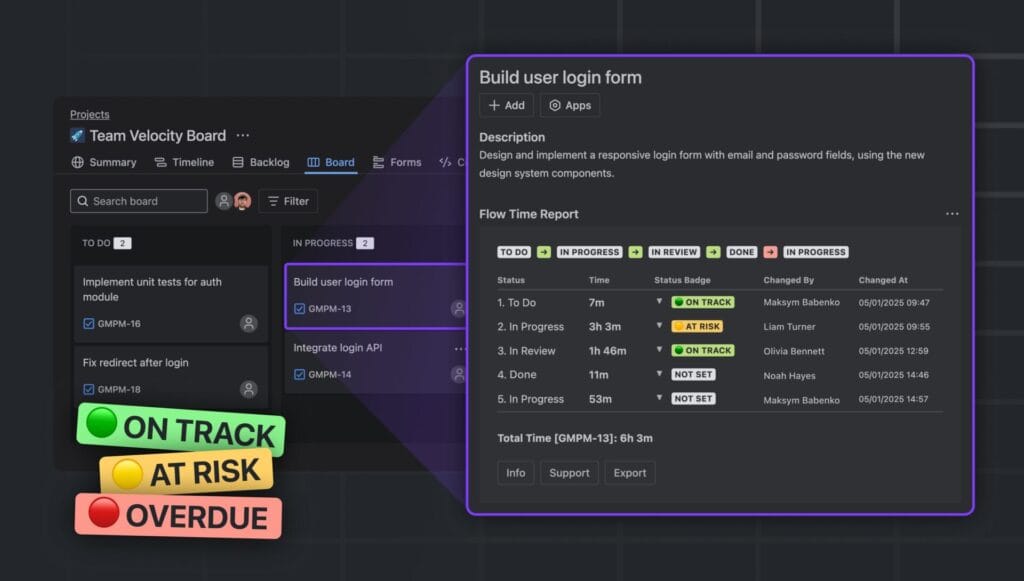
Rather than exporting spreadsheets or setting up complex dashboards, try Flow Time Report — a lightweight Jira Cloud app that gives you the full picture:
- ⏱️ See how long each issue spent in every status
- 👤 Know who moved it, and when
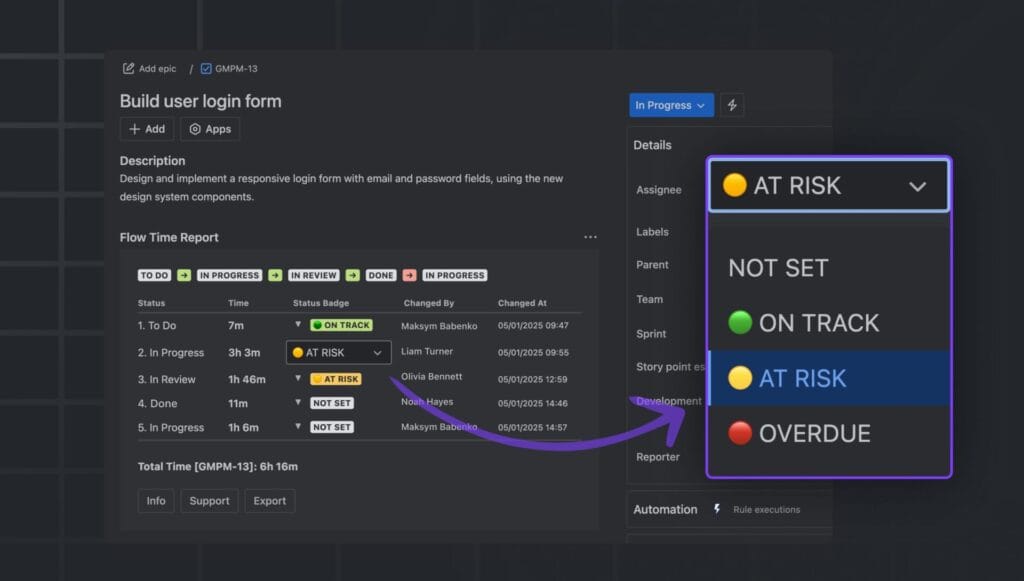
- 🟢🟡🔴 Get visual status badges (On Track / At Risk / Overdue)
- 📤 Export to CSV, JSON, Markdown, or plain text
- 🔍 View insights directly inside the issue panel — no extra setup required
🔗 Install Flow Time Report on the Atlassian Marketplace
💬 One Last Thought
You don’t need more Jira meetings. You need clearer, more informed discussions.
Time-in-status data gives your team the visibility to work smarter, reduce friction, and get more done — together.
Read More
[{"id":4680,"link":"https:\/\/typeswitch.net\/blog\/design-tokens-generator\/","name":"design-tokens-generator","thumbnail":{"url":"https:\/\/typeswitch.net\/wp-content\/uploads\/2026\/07\/visualsnag-catch-style-from-website-or-visual-reference.jpg","alt":"catch-style-from-website-or-visual-reference"},"title":"How to Generate Design Tokens From a Website Screenshot","postMeta":[],"author":{"name":"Babenko Maksym","link":"https:\/\/typeswitch.net\/blog\/author\/max-babenko\/"},"date":"\u041b\u0438\u043f 23, 2026","dateGMT":"2026-07-23 08:06:56","modifiedDate":"2026-07-23 08:30:46","modifiedDateGMT":"2026-07-23 08:30:46","commentCount":"0","commentStatus":"closed","categories":{"coma":"<a href=\"https:\/\/typeswitch.net\/blog\/category\/visualsnag\/\" rel=\"category tag\">VisualSnag<\/a>","space":"<a href=\"https:\/\/typeswitch.net\/blog\/category\/visualsnag\/\" rel=\"category tag\">VisualSnag<\/a>"},"taxonomies":{"post_tag":""},"readTime":{"min":6,"sec":34},"status":"publish","content":"Creating a consistent interface is much easier when visual decisions are written down as reusable rules. Those rules are called"},{"id":4524,"link":"https:\/\/typeswitch.net\/blog\/best-language-switcher-macos\/","name":"best-language-switcher-macos","thumbnail":{"url":"https:\/\/typeswitch.net\/wp-content\/uploads\/2024\/11\/Type-Switch-Personalize-Your-Button.png","alt":"Minimalist design of Type Switch app for language changes on macOS."},"title":"Best Language Switcher for macOS in 2026: Type Switch for Multilingual Typing","postMeta":[],"author":{"name":"Babenko Maksym","link":"https:\/\/typeswitch.net\/blog\/author\/max-babenko\/"},"date":"\u0422\u0440\u0430 17, 2026","dateGMT":"2026-05-17 13:47:43","modifiedDate":"2026-05-17 13:56:53","modifiedDateGMT":"2026-05-17 13:56:53","commentCount":"0","commentStatus":"closed","categories":{"coma":"<a href=\"https:\/\/typeswitch.net\/blog\/category\/uncategorized\/\" rel=\"category tag\">Uncategorized<\/a>","space":"<a href=\"https:\/\/typeswitch.net\/blog\/category\/uncategorized\/\" rel=\"category tag\">Uncategorized<\/a>"},"taxonomies":{"post_tag":""},"readTime":{"min":7,"sec":17},"status":"publish","content":"Working with multiple languages on your Mac should feel natural. But for many people, switching keyboard languages is still one"},{"id":4510,"link":"https:\/\/typeswitch.net\/blog\/best-developer-tools-macos-2026\/","name":"best-developer-tools-macos-2026","thumbnail":{"url":"https:\/\/typeswitch.net\/wp-content\/uploads\/2026\/05\/Preview_1_en.jpg","alt":"quick notes app for Mac"},"title":"Best Developer Tools for macOS in 2026: Essential Mac Apps for Coding","postMeta":[],"author":{"name":"Babenko Maksym","link":"https:\/\/typeswitch.net\/blog\/author\/max-babenko\/"},"date":"\u0422\u0440\u0430 17, 2026","dateGMT":"2026-05-17 07:32:59","modifiedDate":"2026-05-17 07:46:13","modifiedDateGMT":"2026-05-17 07:46:13","commentCount":"0","commentStatus":"closed","categories":{"coma":"<a href=\"https:\/\/typeswitch.net\/blog\/category\/uncategorized\/\" rel=\"category tag\">Uncategorized<\/a>","space":"<a href=\"https:\/\/typeswitch.net\/blog\/category\/uncategorized\/\" rel=\"category tag\">Uncategorized<\/a>"},"taxonomies":{"post_tag":""},"readTime":{"min":9,"sec":1},"status":"publish","content":"macOS is still one of the best environments for developers in 2026. You get a Unix-based system, strong hardware, great"},{"id":4402,"link":"https:\/\/typeswitch.net\/blog\/confluence-public-links-alternative\/","name":"confluence-public-links-alternative","thumbnail":{"url":"https:\/\/typeswitch.net\/wp-content\/uploads\/2026\/05\/Confluence-public-links-alternative.png","alt":"Illustration showing Confluence pages published to the public web with Public Pages for Confluence"},"title":"Confluence Public Links Alternative: Publish Pages with SEO, Branding and Custom Domains","postMeta":[],"author":{"name":"Babenko Maksym","link":"https:\/\/typeswitch.net\/blog\/author\/max-babenko\/"},"date":"\u0422\u0440\u0430 8, 2026","dateGMT":"2026-05-08 16:02:11","modifiedDate":"2026-05-08 17:59:18","modifiedDateGMT":"2026-05-08 17:59:18","commentCount":"0","commentStatus":"closed","categories":{"coma":"<a href=\"https:\/\/typeswitch.net\/blog\/category\/atlassian\/\" rel=\"category tag\">Atlassian<\/a>","space":"<a href=\"https:\/\/typeswitch.net\/blog\/category\/atlassian\/\" rel=\"category tag\">Atlassian<\/a>"},"taxonomies":{"post_tag":""},"readTime":{"min":7,"sec":27},"status":"publish","content":"By Maksym Babenko \u00b7 ~5 min read \u00b7 May 8, 2026 Confluence public links are useful when you need to share a page"}]