Lightweight, contextual risk scoring that lives where your work happens.

🚨 Why Risk Management in Jira Matters
In fast-moving Agile teams, effective risk management isn’t a luxury — it’s essential.
Yet many teams still manage risks outside Jira: in spreadsheets, Confluence tables, or third-party systems.
This leads to:
- Outdated risk data
- Disconnected workflows
- Risks forgotten mid-sprint
- No clear link between work and risk impact
❌ Result: Teams are surprised by blockers, complexity, or dependencies — too late to react.
💡 There’s a Better Way
Risk Radar brings risk awareness directly into your Jira issues — where your team already works.
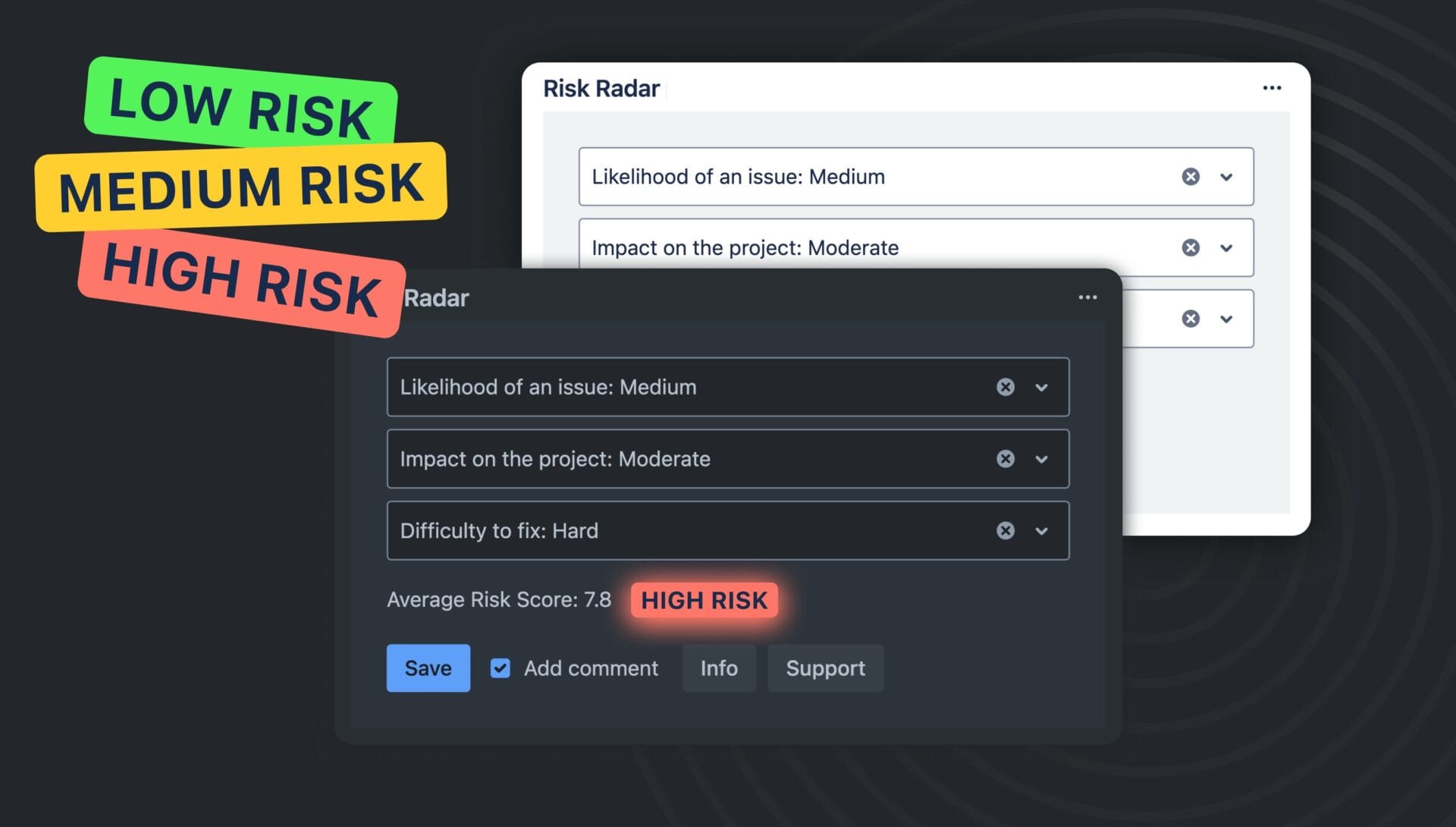
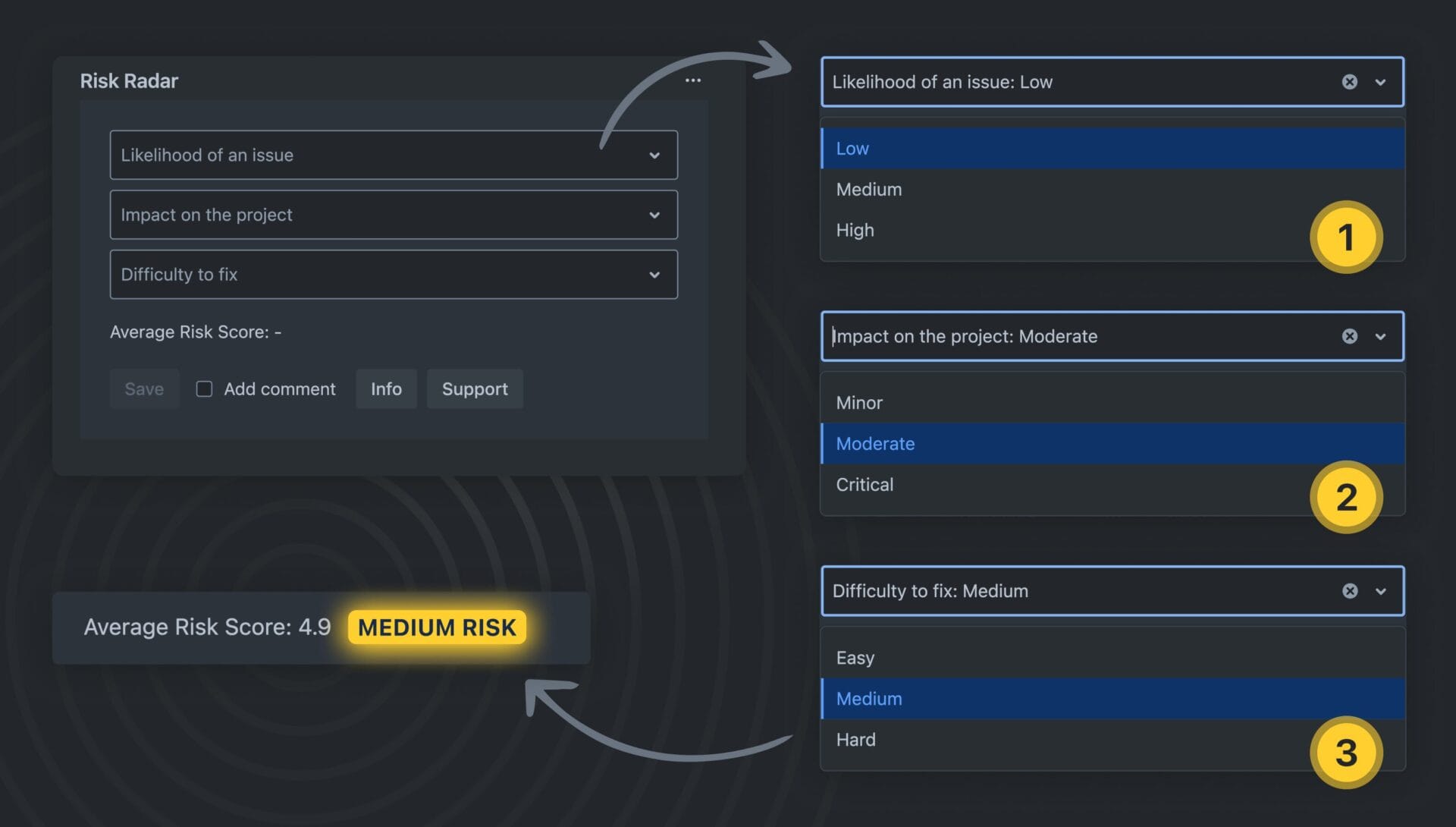
With just a few clicks, you can assess the Likelihood, Impact, and Difficulty of each task — and instantly calculate a Risk Score that’s visible to the whole team.
How Risk Radar Works
- Open any Jira issue
- Select values for:
- ✅ Probability of failure
- ✅ Business impact
- ✅ Resolution difficulty
- Let Risk Radar calculate the score (1–10) using our smart weighted formula
- Visual indicator shows the level:
- 🟢 Low Risk
- 🟡 Medium Risk
- 🔴 High Risk
- The score is saved inside the issue (via properties), always up to date
🧠 Benefits of Risk Assessment Inside Jira
✅ Spot risks early — not after the sprint starts
Assess risks during backlog grooming or issue creation to flag critical items early.
✅ Prioritize with clarity
Split or defer tasks with high risk. Assign extra review time or more experienced team members.
✅ Align the whole team
When risk is visible in the issue view, everyone — from devs to QA to PMs — can make informed decisions.
✅ Keep it lightweight
No spreadsheets, no external tools, no context-switching. Just fast, in-flow insights.
Real-World Use Cases
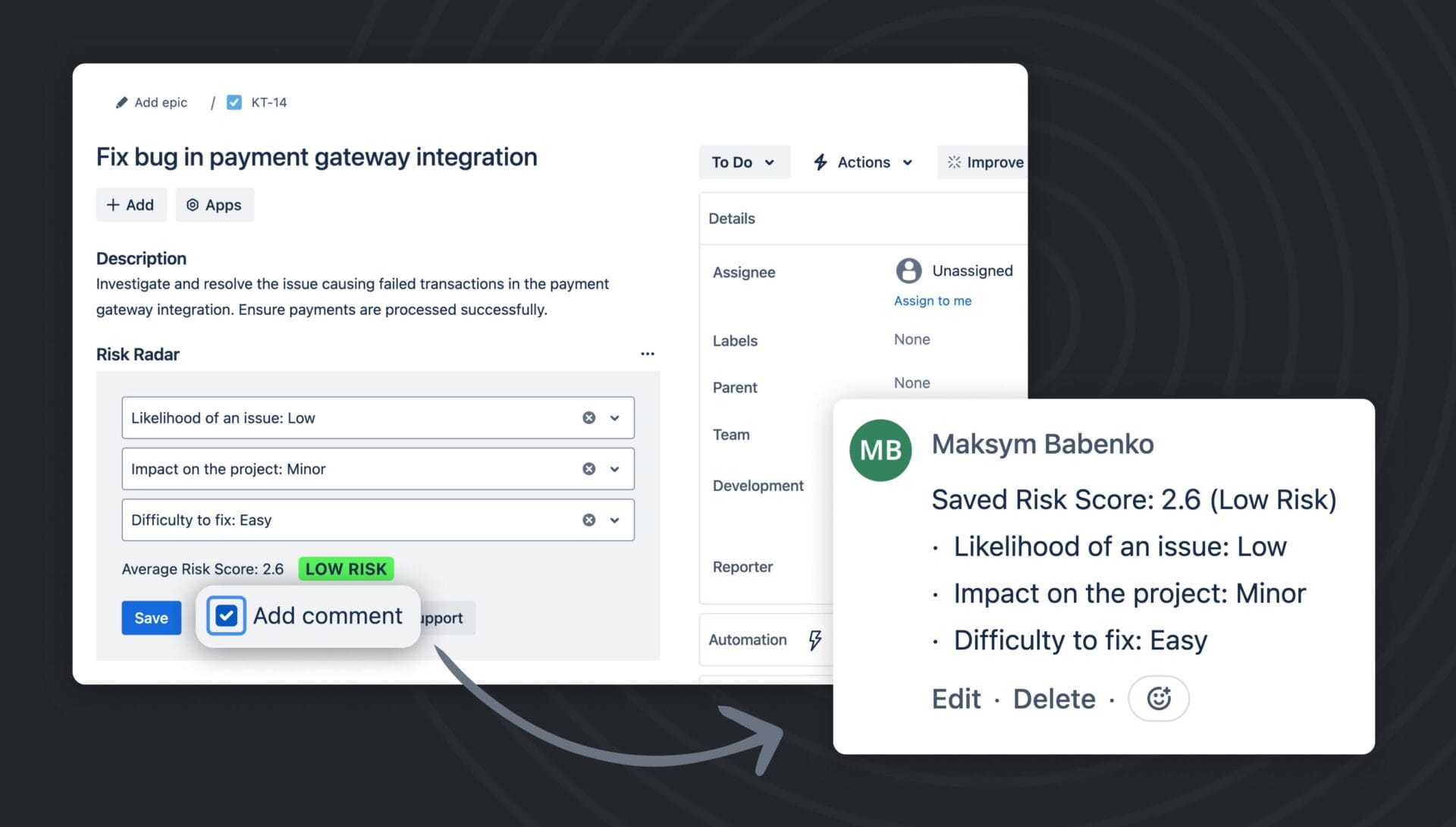
Use Case #1: Risk-Aware Sprint Planning
During sprint planning, your team identifies an issue integrating with a third-party payment API.
The Risk Radar score is 8.9 (High Risk) due to unstable API docs and high business impact.
📌 Action taken:
- Task is broken into smaller spikes
- Added QA fallback plan
- Assigned to senior developer
- Flagged for extra stakeholder check-in
🎯 Result: No sprint delay. Mitigation was planned from day one.
Use Case #2: Reducing Last-Minute Blockers
In a previous sprint, two tasks sat in “Blocked” for 4 days — unnoticed.
In the retro, Risk Radar showed both had been scored High Risk but no one monitored them.
📌 Action taken:
- Created dashboard with high-risk issues
- Added Slack notifications when risk score ≥ 7
- Used risk score as a filter in standups
🎯 Result: Blockers flagged earlier. Fewer surprises. Team stress dropped.
Use Case #3: Managing Tech Debt with Risk Score
You’ve got several “refactor later” tickets. Normally low-priority — but Risk Radar shows some carry a Risk Score of 7.2 due to high failure impact.
📌 Action taken:
- Re-prioritized during grooming
- Added spike to explore one task more deeply
- Converted risky task into epic for gradual cleanup
🎯 Result: Team cleaned up dangerous tech debt before it caused production issues.
Who Uses Risk Radar?
Risk Radar is designed for:
- Agile, Scrum, and Kanban teams
- DevOps and Platform teams managing technical complexity
- QA and Testing teams wanting to assess delivery risk
- Product managers and delivery leads needing visibility without bureaucracy
Start in Under 2 Minutes
- No setup required
- Works out-of-the-box inside any Jira issue
- Risk Score saved with the issue
- Visible, consistent, and always up to date
🛠️ Built with Atlassian Forge → secure, fast, and natively integrated.
How to Use It in Your Workflow
📌 Backlog Grooming:
Tag risky tasks immediately and decide whether to split, defer, or mitigate.
📌 Sprint Planning:
Use risk score to assign ownership, prioritize sequence, or estimate complexity.
📌 Daily Standups:
Watch for high-risk issues that remain untouched. Reassign or unblock fast.
📌 Retrospectives:
Review which risks materialized — what you predicted correctly and what surprised you.
Why Teams Love Risk Radar
✅ Clear visual signals inside each issue
✅ Instant risk assessment in under 10 seconds
✅ No spreadsheets, Confluence tables, or tools to update
✅ Promotes proactive delivery without micromanagement
✨ Bonus: Smart Formula, Not Just Labels
Our risk model isn’t based on vague “High/Low” dropdowns — it uses:
- Weighted scoring
- Adjustments based on impact/difficulty combos
- Normalization to a 1–10 scale
🎯 Real insight, not guesswork.
Ready to Embed Risk Management Into Your Delivery Flow?
Try Risk Radar for Jira Cloud — free for small teams (up to 10 users) and with a 30-day trial for everyone else.
👉 Free on Atlassian Marketplace
👉 Contact us for feedback or feature requests
Read More
[{"id":4680,"link":"https:\/\/typeswitch.net\/blog\/design-tokens-generator\/","name":"design-tokens-generator","thumbnail":{"url":"https:\/\/typeswitch.net\/wp-content\/uploads\/2026\/07\/visualsnag-catch-style-from-website-or-visual-reference.jpg","alt":"catch-style-from-website-or-visual-reference"},"title":"How to Generate Design Tokens From a Website Screenshot","postMeta":[],"author":{"name":"Babenko Maksym","link":"https:\/\/typeswitch.net\/blog\/author\/max-babenko\/"},"date":"\u041b\u0438\u043f 23, 2026","dateGMT":"2026-07-23 08:06:56","modifiedDate":"2026-07-23 08:30:46","modifiedDateGMT":"2026-07-23 08:30:46","commentCount":"0","commentStatus":"closed","categories":{"coma":"<a href=\"https:\/\/typeswitch.net\/blog\/category\/visualsnag\/\" rel=\"category tag\">VisualSnag<\/a>","space":"<a href=\"https:\/\/typeswitch.net\/blog\/category\/visualsnag\/\" rel=\"category tag\">VisualSnag<\/a>"},"taxonomies":{"post_tag":""},"readTime":{"min":6,"sec":34},"status":"publish","content":"Creating a consistent interface is much easier when visual decisions are written down as reusable rules. Those rules are called"},{"id":4524,"link":"https:\/\/typeswitch.net\/blog\/best-language-switcher-macos\/","name":"best-language-switcher-macos","thumbnail":{"url":"https:\/\/typeswitch.net\/wp-content\/uploads\/2024\/11\/Type-Switch-Personalize-Your-Button.png","alt":"Minimalist design of Type Switch app for language changes on macOS."},"title":"Best Language Switcher for macOS in 2026: Type Switch for Multilingual Typing","postMeta":[],"author":{"name":"Babenko Maksym","link":"https:\/\/typeswitch.net\/blog\/author\/max-babenko\/"},"date":"\u0422\u0440\u0430 17, 2026","dateGMT":"2026-05-17 13:47:43","modifiedDate":"2026-05-17 13:56:53","modifiedDateGMT":"2026-05-17 13:56:53","commentCount":"0","commentStatus":"closed","categories":{"coma":"<a href=\"https:\/\/typeswitch.net\/blog\/category\/uncategorized\/\" rel=\"category tag\">Uncategorized<\/a>","space":"<a href=\"https:\/\/typeswitch.net\/blog\/category\/uncategorized\/\" rel=\"category tag\">Uncategorized<\/a>"},"taxonomies":{"post_tag":""},"readTime":{"min":7,"sec":17},"status":"publish","content":"Working with multiple languages on your Mac should feel natural. But for many people, switching keyboard languages is still one"},{"id":4510,"link":"https:\/\/typeswitch.net\/blog\/best-developer-tools-macos-2026\/","name":"best-developer-tools-macos-2026","thumbnail":{"url":"https:\/\/typeswitch.net\/wp-content\/uploads\/2026\/05\/Preview_1_en.jpg","alt":"quick notes app for Mac"},"title":"Best Developer Tools for macOS in 2026: Essential Mac Apps for Coding","postMeta":[],"author":{"name":"Babenko Maksym","link":"https:\/\/typeswitch.net\/blog\/author\/max-babenko\/"},"date":"\u0422\u0440\u0430 17, 2026","dateGMT":"2026-05-17 07:32:59","modifiedDate":"2026-05-17 07:46:13","modifiedDateGMT":"2026-05-17 07:46:13","commentCount":"0","commentStatus":"closed","categories":{"coma":"<a href=\"https:\/\/typeswitch.net\/blog\/category\/uncategorized\/\" rel=\"category tag\">Uncategorized<\/a>","space":"<a href=\"https:\/\/typeswitch.net\/blog\/category\/uncategorized\/\" rel=\"category tag\">Uncategorized<\/a>"},"taxonomies":{"post_tag":""},"readTime":{"min":9,"sec":1},"status":"publish","content":"macOS is still one of the best environments for developers in 2026. You get a Unix-based system, strong hardware, great"},{"id":4402,"link":"https:\/\/typeswitch.net\/blog\/confluence-public-links-alternative\/","name":"confluence-public-links-alternative","thumbnail":{"url":"https:\/\/typeswitch.net\/wp-content\/uploads\/2026\/05\/Confluence-public-links-alternative.png","alt":"Illustration showing Confluence pages published to the public web with Public Pages for Confluence"},"title":"Confluence Public Links Alternative: Publish Pages with SEO, Branding and Custom Domains","postMeta":[],"author":{"name":"Babenko Maksym","link":"https:\/\/typeswitch.net\/blog\/author\/max-babenko\/"},"date":"\u0422\u0440\u0430 8, 2026","dateGMT":"2026-05-08 16:02:11","modifiedDate":"2026-05-08 17:59:18","modifiedDateGMT":"2026-05-08 17:59:18","commentCount":"0","commentStatus":"closed","categories":{"coma":"<a href=\"https:\/\/typeswitch.net\/blog\/category\/atlassian\/\" rel=\"category tag\">Atlassian<\/a>","space":"<a href=\"https:\/\/typeswitch.net\/blog\/category\/atlassian\/\" rel=\"category tag\">Atlassian<\/a>"},"taxonomies":{"post_tag":""},"readTime":{"min":7,"sec":27},"status":"publish","content":"By Maksym Babenko \u00b7 ~5 min read \u00b7 May 8, 2026 Confluence public links are useful when you need to share a page"}]