How to Calculate RICE Scores in Jira for Data-Driven Product Prioritization
RICE (Reach, Impact, Confidence, Effort) is one of the most respected prioritization frameworks in product management.
But Jira doesn’t support RICE natively, forcing teams to use spreadsheets or lightweight custom fields that cannot calculate formulas.
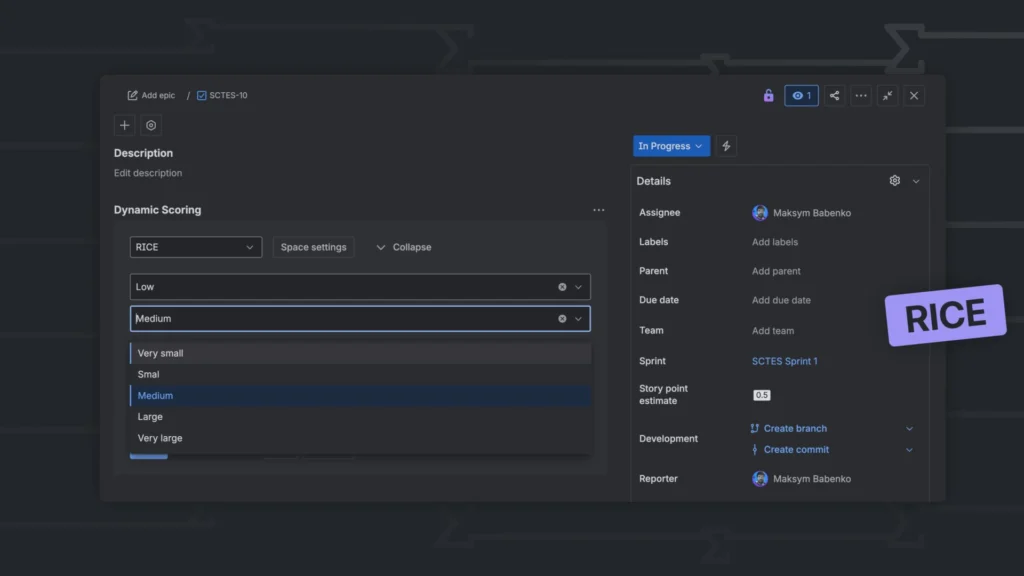
Dynamic Scoring for Jira solves this by enabling full RICE calculation directly inside the issue view.
Why RICE Has Become a Product Management Standard
RICE was created by Intercom to improve decision-making during product discovery.
Its formula:
RICE = (Reach × Impact × Confidence) ÷ Effort
Each component adds unique value:
Reach: How many users/customers this will affect.
Impact: How strongly it will affect them (e.g., low → massive).
Confidence: How certain you are about Reach/Impact estimates.
Prevents wishful thinking.
Effort: How long it will take; encourages fast, high-value delivery.
Why RICE Helps Teams Prioritize Better
- Balances optimism with realism through Confidence.
- Encourages customer-centric thinking with Reach.
- Produces one comparable score for all ideas.
- Improves roadmap discussions by giving PMs a structured argument.
Configuring RICE in Jira with Dynamic Scoring

Best Model: Weighted
Supports multiplicative logic through weighted scores.
Step-by-Step RICE Configuration
1. Create a New Configuration → Name: RICE
2. Select Scoring Type → Weighted
3. Add the four dropdowns
| Field | Options | Notes |
|---|---|---|
| Reach | 100 / 1,000 / 10,000 | Reflects user reach |
| Impact | 1–5 | Minimal → Massive |
| Confidence | 0.1 / 0.5 / 1.0 | Represents uncertainty |
| Effort | 1 / 3 / 8 / 20 | Use Fibonacci or T-shirt sizes |
4. Set All Weights to 1
This ensures each component is included correctly in the RICE equation.
5. Save → Use in Issues
The RICE score updates instantly whenever inputs change.
Practical Examples of RICE in Action
• Feature discovery
Score dozens of ideas quickly during discovery sprints.
• Customer-facing initiatives
Reach makes it perfect for B2C or large user bases.
• Growth experiments
Confidence reduces the risk of chasing low-certainty ideas.
• Cross-team prioritization
Teams get a shared scoring system everyone understands.
Beyond RICE
Dynamic Scoring also supports lighter scoring approaches like ICE or deeper Lean approaches like WSJF.
Use RICE when evaluating many ideas and switch to WSJF for delivery flow optimization.
Read More
[{"id":4680,"link":"https:\/\/typeswitch.net\/blog\/design-tokens-generator\/","name":"design-tokens-generator","thumbnail":{"url":"https:\/\/typeswitch.net\/wp-content\/uploads\/2026\/07\/visualsnag-catch-style-from-website-or-visual-reference.jpg","alt":"catch-style-from-website-or-visual-reference"},"title":"How to Generate Design Tokens From a Website Screenshot","postMeta":[],"author":{"name":"Babenko Maksym","link":"https:\/\/typeswitch.net\/blog\/author\/max-babenko\/"},"date":"\u041b\u0438\u043f 23, 2026","dateGMT":"2026-07-23 08:06:56","modifiedDate":"2026-07-23 08:30:46","modifiedDateGMT":"2026-07-23 08:30:46","commentCount":"0","commentStatus":"closed","categories":{"coma":"<a href=\"https:\/\/typeswitch.net\/blog\/category\/visualsnag\/\" rel=\"category tag\">VisualSnag<\/a>","space":"<a href=\"https:\/\/typeswitch.net\/blog\/category\/visualsnag\/\" rel=\"category tag\">VisualSnag<\/a>"},"taxonomies":{"post_tag":""},"readTime":{"min":6,"sec":34},"status":"publish","content":"Creating a consistent interface is much easier when visual decisions are written down as reusable rules. Those rules are called"},{"id":4524,"link":"https:\/\/typeswitch.net\/blog\/best-language-switcher-macos\/","name":"best-language-switcher-macos","thumbnail":{"url":"https:\/\/typeswitch.net\/wp-content\/uploads\/2024\/11\/Type-Switch-Personalize-Your-Button.png","alt":"Minimalist design of Type Switch app for language changes on macOS."},"title":"Best Language Switcher for macOS in 2026: Type Switch for Multilingual Typing","postMeta":[],"author":{"name":"Babenko Maksym","link":"https:\/\/typeswitch.net\/blog\/author\/max-babenko\/"},"date":"\u0422\u0440\u0430 17, 2026","dateGMT":"2026-05-17 13:47:43","modifiedDate":"2026-05-17 13:56:53","modifiedDateGMT":"2026-05-17 13:56:53","commentCount":"0","commentStatus":"closed","categories":{"coma":"<a href=\"https:\/\/typeswitch.net\/blog\/category\/uncategorized\/\" rel=\"category tag\">Uncategorized<\/a>","space":"<a href=\"https:\/\/typeswitch.net\/blog\/category\/uncategorized\/\" rel=\"category tag\">Uncategorized<\/a>"},"taxonomies":{"post_tag":""},"readTime":{"min":7,"sec":17},"status":"publish","content":"Working with multiple languages on your Mac should feel natural. But for many people, switching keyboard languages is still one"},{"id":4510,"link":"https:\/\/typeswitch.net\/blog\/best-developer-tools-macos-2026\/","name":"best-developer-tools-macos-2026","thumbnail":{"url":"https:\/\/typeswitch.net\/wp-content\/uploads\/2026\/05\/Preview_1_en.jpg","alt":"quick notes app for Mac"},"title":"Best Developer Tools for macOS in 2026: Essential Mac Apps for Coding","postMeta":[],"author":{"name":"Babenko Maksym","link":"https:\/\/typeswitch.net\/blog\/author\/max-babenko\/"},"date":"\u0422\u0440\u0430 17, 2026","dateGMT":"2026-05-17 07:32:59","modifiedDate":"2026-05-17 07:46:13","modifiedDateGMT":"2026-05-17 07:46:13","commentCount":"0","commentStatus":"closed","categories":{"coma":"<a href=\"https:\/\/typeswitch.net\/blog\/category\/uncategorized\/\" rel=\"category tag\">Uncategorized<\/a>","space":"<a href=\"https:\/\/typeswitch.net\/blog\/category\/uncategorized\/\" rel=\"category tag\">Uncategorized<\/a>"},"taxonomies":{"post_tag":""},"readTime":{"min":9,"sec":1},"status":"publish","content":"macOS is still one of the best environments for developers in 2026. You get a Unix-based system, strong hardware, great"},{"id":4402,"link":"https:\/\/typeswitch.net\/blog\/confluence-public-links-alternative\/","name":"confluence-public-links-alternative","thumbnail":{"url":"https:\/\/typeswitch.net\/wp-content\/uploads\/2026\/05\/Confluence-public-links-alternative.png","alt":"Illustration showing Confluence pages published to the public web with Public Pages for Confluence"},"title":"Confluence Public Links Alternative: Publish Pages with SEO, Branding and Custom Domains","postMeta":[],"author":{"name":"Babenko Maksym","link":"https:\/\/typeswitch.net\/blog\/author\/max-babenko\/"},"date":"\u0422\u0440\u0430 8, 2026","dateGMT":"2026-05-08 16:02:11","modifiedDate":"2026-05-08 17:59:18","modifiedDateGMT":"2026-05-08 17:59:18","commentCount":"0","commentStatus":"closed","categories":{"coma":"<a href=\"https:\/\/typeswitch.net\/blog\/category\/atlassian\/\" rel=\"category tag\">Atlassian<\/a>","space":"<a href=\"https:\/\/typeswitch.net\/blog\/category\/atlassian\/\" rel=\"category tag\">Atlassian<\/a>"},"taxonomies":{"post_tag":""},"readTime":{"min":7,"sec":27},"status":"publish","content":"By Maksym Babenko \u00b7 ~5 min read \u00b7 May 8, 2026 Confluence public links are useful when you need to share a page"}]