How to Calculate ROI in Jira for Better Investment Decisions Using Dynamic Scoring
Return on Investment (ROI) is essential for teams evaluating whether a feature, project, or initiative is worth the cost. But Jira was never designed for financial metrics until now.
Dynamic Scoring for Jira introduces a dedicated Financial scoring model that lets teams calculate ROI directly in the issue view, turning Jira into a lightweight investment assessment platform.
Why ROI Matters for Modern Product Organizations
ROI is one of the simplest and most universal financial metrics:
ROI = (Value – Cost) ÷ Cost
ROI provides three powerful benefits:
1. Strong business justification
It gives leadership a clear, quantitative view of why a feature deserves investment.
2. Improved capital allocation
Portfolios often have dozens of competing initiatives; ROI highlights which ones bring the biggest return per dollar spent.
3. Clearer decision-making
ROI supports go/no-go decisions, especially for expensive projects.
Why ROI in Jira Is Hard Without a Tool
Teams typically rely on:
- spreadsheets
- slide decks
- rough “effort vs. value” discussions
This leads to scattered documentation and data that quickly becomes outdated.
With Dynamic Scoring, ROI becomes:
- consistent
- visible
- part of every issue
- easy to compare across epics and features
How to Configure ROI in Jira Using Dynamic Scoring
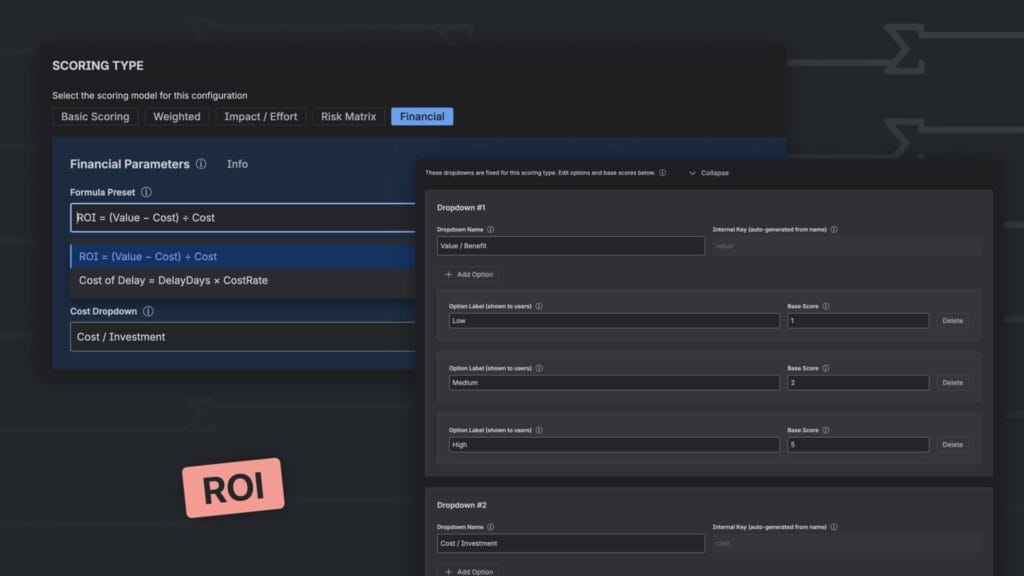
Best Model: Financial
The Financial scoring type includes a built-in ROI formula.
Step-by-Step ROI Configuration
1. Create the Configuration
Name: ROI
2. Select Scoring Type
Choose: Financial
3. Add the required dropdowns
| Field | Purpose | Options |
|---|---|---|
| Value / Benefit | Expected business or customer value | Low / Medium / High |
| Cost / Investment | Cost, effort, or budget | Low / Medium / High |
You can assign real numerical values or proxy scores.
4. Select Formula Preset
Choose the built-in formula:
ROI = (Value – Cost) ÷ Cost
5. Save → Use in Jira Issue View
Instant ROI scoring for every initiative.
How Agile Teams Use ROI in Practice

• Strategic Roadmapping
Helps prioritize high-value long-term projects.
• Leadership alignment
Provides a shared financial language between PMs, Engineering, and executives.
• Portfolio management
Supports multi-product organizations selecting which initiatives to fund.
Beyond ROI
Dynamic Scoring also supports:
- Risk-adjusted ROI
- Weighted decision models
- Risk Matrix scoring
- WSJF and other Lean metrics
- Custom formulas for financial teams
This flexibility makes it useful for both product and strategic leadership.
Read More
[{"id":4024,"link":"https:\/\/typeswitch.net\/blog\/best-jira-apps-agile-teams-2026\/","name":"best-jira-apps-agile-teams-2026","thumbnail":{"url":"https:\/\/typeswitch.net\/wp-content\/uploads\/2026\/02\/best-jira-apps-2026-8fc0c8.svg","alt":""},"title":"The Best Jira Apps Every Agile Team Needs in 2026: Sprint Health, Risk, Flow Metrics & Prioritization.","postMeta":[],"author":{"name":"meltedmensoftware@gmail.com","link":"https:\/\/typeswitch.net\/blog\/author\/meltedmensoftwaregmail-com\/"},"date":"\u041b\u044e\u0442 25, 2026","dateGMT":"2026-02-25 08:30:06","modifiedDate":"2026-02-25 08:45:52","modifiedDateGMT":"2026-02-25 08:45:52","commentCount":"0","commentStatus":"closed","categories":{"coma":"<a href=\"https:\/\/typeswitch.net\/blog\/category\/atlassian\/\" rel=\"category tag\">Atlassian<\/a>, <a href=\"https:\/\/typeswitch.net\/blog\/category\/atlassian\/jira-app\/\" rel=\"category tag\">Jira App<\/a>","space":"<a href=\"https:\/\/typeswitch.net\/blog\/category\/atlassian\/\" rel=\"category tag\">Atlassian<\/a> <a href=\"https:\/\/typeswitch.net\/blog\/category\/atlassian\/jira-app\/\" rel=\"category tag\">Jira App<\/a>"},"taxonomies":{"post_tag":""},"readTime":{"min":8,"sec":38},"status":"publish","content":"Every Jira team has a version of this story. The sprint ends. The retrospective starts. Someone pulls up the board"},{"id":4007,"link":"https:\/\/typeswitch.net\/blog\/time-in-status-jira-2026\/","name":"time-in-status-jira-2026","thumbnail":{"url":"https:\/\/typeswitch.net\/wp-content\/uploads\/2026\/02\/Time-in-Status-for-Jira.jpg","alt":""},"title":"Time in Status in Jira: How Agile Teams Find Bottlenecks and Ship Faster (2026 Guide)","postMeta":[],"author":{"name":"meltedmensoftware@gmail.com","link":"https:\/\/typeswitch.net\/blog\/author\/meltedmensoftwaregmail-com\/"},"date":"\u041b\u044e\u0442 22, 2026","dateGMT":"2026-02-22 07:47:20","modifiedDate":"2026-02-22 11:20:53","modifiedDateGMT":"2026-02-22 11:20:53","commentCount":"0","commentStatus":"closed","categories":{"coma":"<a href=\"https:\/\/typeswitch.net\/blog\/category\/atlassian\/\" rel=\"category tag\">Atlassian<\/a>, <a href=\"https:\/\/typeswitch.net\/blog\/category\/atlassian\/jira-app\/\" rel=\"category tag\">Jira App<\/a>","space":"<a href=\"https:\/\/typeswitch.net\/blog\/category\/atlassian\/\" rel=\"category tag\">Atlassian<\/a> <a href=\"https:\/\/typeswitch.net\/blog\/category\/atlassian\/jira-app\/\" rel=\"category tag\">Jira App<\/a>"},"taxonomies":{"post_tag":""},"readTime":{"min":6,"sec":57},"status":"publish","content":"Time in Status in Jira is a workflow metric that measures how long each issue spends in every status \u2014"},{"id":3995,"link":"https:\/\/typeswitch.net\/blog\/risk-management-in-jira-2026\/","name":"risk-management-in-jira-2026","thumbnail":{"url":"https:\/\/typeswitch.net\/wp-content\/uploads\/2026\/02\/Risk-Management-for-Jira.jpg","alt":""},"title":"Risk Management in Jira: How Agile Teams Detect Problems Before They Happen (2026 Guide)","postMeta":[],"author":{"name":"meltedmensoftware@gmail.com","link":"https:\/\/typeswitch.net\/blog\/author\/meltedmensoftwaregmail-com\/"},"date":"\u041b\u044e\u0442 21, 2026","dateGMT":"2026-02-21 08:05:47","modifiedDate":"2026-02-22 11:21:20","modifiedDateGMT":"2026-02-22 11:21:20","commentCount":"0","commentStatus":"closed","categories":{"coma":"<a href=\"https:\/\/typeswitch.net\/blog\/category\/atlassian\/\" rel=\"category tag\">Atlassian<\/a>, <a href=\"https:\/\/typeswitch.net\/blog\/category\/atlassian\/jira-app\/\" rel=\"category tag\">Jira App<\/a>","space":"<a href=\"https:\/\/typeswitch.net\/blog\/category\/atlassian\/\" rel=\"category tag\">Atlassian<\/a> <a href=\"https:\/\/typeswitch.net\/blog\/category\/atlassian\/jira-app\/\" rel=\"category tag\">Jira App<\/a>"},"taxonomies":{"post_tag":""},"readTime":{"min":5,"sec":38},"status":"publish","content":"Risk management in Jira is the practice of identifying, scoring, and tracking potential delivery problems directly inside Jira issues, before"},{"id":3372,"link":"https:\/\/typeswitch.net\/blog\/ice-in-jira-impact-confidence-effort-fast-prioritization-using-dynamic-scoring\/","name":"ice-in-jira-impact-confidence-effort-fast-prioritization-using-dynamic-scoring","thumbnail":{"url":"https:\/\/typeswitch.net\/wp-content\/uploads\/2025\/12\/ICE.jpg","alt":""},"title":"ICE in Jira (Impact, Confidence, Effort): Fast Prioritization Using Dynamic Scoring","postMeta":[],"author":{"name":"meltedmensoftware@gmail.com","link":"https:\/\/typeswitch.net\/blog\/author\/meltedmensoftwaregmail-com\/"},"date":"\u0413\u0440\u0443 2, 2025","dateGMT":"2025-12-02 13:08:51","modifiedDate":"2025-12-12 08:30:02","modifiedDateGMT":"2025-12-12 08:30:02","commentCount":"0","commentStatus":"closed","categories":{"coma":"<a href=\"https:\/\/typeswitch.net\/blog\/category\/atlassian\/jira-app\/\" rel=\"category tag\">Jira App<\/a>","space":"<a href=\"https:\/\/typeswitch.net\/blog\/category\/atlassian\/jira-app\/\" rel=\"category tag\">Jira App<\/a>"},"taxonomies":{"post_tag":""},"readTime":{"min":1,"sec":42},"status":"publish","content":"How to Calculate ICE Scores in Jira for Fast, Lightweight Prioritization The ICE framework (Impact, Confidence, Effort) is a simple"}]